
Crimson Desert vs Elden Ring: Which Open-World RPG Deserves Your Time?
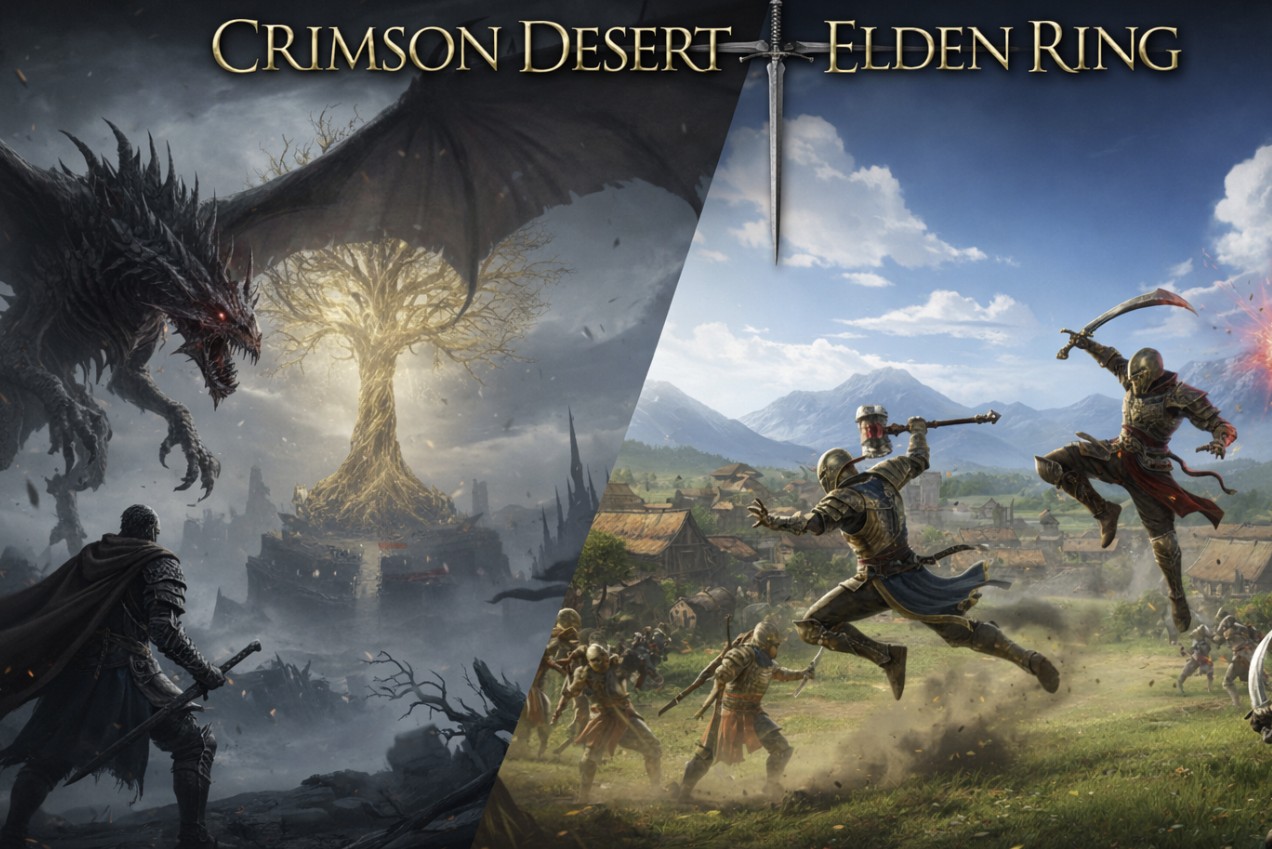
This comparison is based on published critic reviews, hands-on previews, and community feedback from launch week. Crimson Desert launched on March 19, 2026 on PC, PS5, and Xbox Series X/S. Elden Ring (2022) is evaluated with its Shadow of the Erdtree expansion in mind.
When Crimson Desert finally released in March 2026, the gaming internet immediately did what it does best: compared it to Elden Ring. The comparison was always going to happen. Both games are third-person action RPGs set in vast, dangerous fantasy worlds. Both feature epic boss fights that have players grinding their teeth. Both demand patience and reward exploration.
But after playing both extensively, the honest answer is: these games have very little in common underneath the surface. Choosing between them isn't really about picking the "better" game, it's about understanding what kind of experience you actually want.
Here's a thorough breakdown across every dimension that matters.
Are Crimson Desert and Elden Ring the Same Kind of Game?
| Criteria | 🔴 Crimson Desert | 🔵 Elden Ring |
|---|---|---|
| Genre | Open-world action adventure | Soulslike action RPG |
| Developer | Pearl Abyss (South Korea) | FromSoftware (Japan) |
| Release | March 19, 2026 | February 25, 2022 |
| Metacritic | 78/100 | 96/100 |
| Story style | Cinematic, explicit cutscenes — but weak narrative | Environmental, fragmented — deeply rich lore |
| Combat | Fast, spectacular, skill-chain combos | Deliberate, stamina-based, punishing |
| Map size | ~80 km² (twice Skyrim) | ~80 km² (similar, but denser) |
| Playtime | 120–140h main story / 400h completion | 50–60h base / 150h+ with DLC |
| Difficulty | Spiky, some punishing bosses | Consistently hard, deeply fair |
| Graphics | Technically stunning, 2026 benchmark | Artistic, timeless, less detailed |
| Platforms | PC, PS5, Xbox Series, macOS | PC, PS4/5, Xbox, Switch |
| Multiplayer | Single-player only at launch | Full co-op & PvP |
The short answer is no. Elden Ring is a Soulslike — a punishing, deliberate, atmospheric action RPG that demands mastery, and punishes failure with the loss of accumulated resources. Crimson Desert is closer to a cinematic open-world action game. Pearl Abyss has been clear about this: "When people see the boss fights in this game, they immediately think Soulslike," said the studio's PR director Will Powers, before explaining that the game doesn't use narrow dodge windows, stamina gates, or the death-and-respawn loop that defines the genre.
That said, the two games overlap enough to create genuine confusion. Crimson Desert's open world lets you walk away from difficult bosses and come back later exactly as Elden Ring's Lands Between allowed. Both games feature intricate skill systems. Both have enemies that will absolutely punish you for being sloppy.
Think of it this way: Elden Ring is a precision instrument. Crimson Desert is a symphony orchestra that occasionally gets too loud.
How Does Combat Compare Between the Two Games?
This is where the two games diverge most dramatically and where Crimson Desert actually has a legitimate claim to superiority, at least on paper.
Crimson Desert's combat is built around fluid, extravagant chains of attacks. You can mix strikes, grapples, aerial moves, weapon abilities, and magical powers from the Abyss into seamless combos. Every fight feels like a choreographed action sequence. On PS5, the DualSense haptics add genuine weight to every clash and parry. The skill tree is deep enough that after dozens of hours, you're still unlocking new moves and skills evolve as you invest in them, turning a basic grappling hook into a Spider-Man-style traversal tool.
But there's a catch: Crimson Desert's controls take significant time to click. Multiple reviewers noted an 8+ hour learning curve before the combat starts to feel natural. The lock-on system drew consistent criticism. And the difficulty spikes particularly certain story bosses feel inconsistent rather than expertly calibrated.
Elden Ring's combat is the opposite philosophy. Fewer moves, infinite depth. Each swing of a weapon carries consequence because stamina and positioning are everything. The parry system rewards patience. The build variety is staggering sorcerer, faith caster, bleed katana, strength cosplay and each fundamentally changes how the game plays. Every death in Elden Ring teaches you something specific. Every death in Crimson Desert can feel like the game being unfair.
"Dark Souls has often been used to measure one's gaming prowess, but that measuring stick has changed with Crimson Desert. Not only does it boast some of the most challenging boss battles ever seen, its required levels of patience and determination have set a new gold standard."
The Outerhaven, 100/100
Which Game Has the Better Open World?
This is genuinely contested and the answer depends entirely on what you want from an open world.
Crimson Desert's continent of Pywel is, by almost any technical measure, extraordinary. At roughly 80 km², it's massive. But more importantly, it's dense. Bustling cities, hidden ruins, floating sky realms called the Abyss, dragon mounts, mechs, go-karts, ancient puzzles — Pearl Abyss seemingly tried to include everything they'd ever wanted in a game. Reviewers at JeuxActu who put in 110+ hours described a world that feels genuinely alive, where the best moments come from simply wandering without a destination.
Elden Ring's Lands Between is smaller and less technically impressive, but almost universally regarded as one of the greatest game worlds ever designed. The density of secrets, the way legacy dungeons reward methodical exploration, the way every ruin tells a story it's the product of FromSoftware operating at the peak of their craft. The DLC, Shadow of the Erdtree, added another enormous area of comparable quality. Together, you're looking at 150+ hours of expertly curated exploration.
The difference is curation vs abundance. Elden Ring curates every item placement and enemy location feels intentional. Crimson Desert floods you which is thrilling, but occasionally overwhelming and unfocused.
Crimson DesertBest for: The Overwhelmed Explorer
You want a world you can get lost in for hundreds of hours. You don't mind not understanding everything immediately. You prioritize spectacle and freedom over curation and meaning.
Elden RingBest for: The Deliberate Discoverer
Every cave you find feels earned. The lore rewards the patient. A smaller, denser world where secrets feel like genuine secrets, not just map markers waiting to be cleared.
Which Game Has a Better Story?
Both games have been criticized for their narratives but for completely opposite reasons.
Crimson Desert tells the story of Kliff, a mercenary leader rebuilding his Greymane faction after a devastating ambush. It's delivered through high-budget cinematic cutscenes in a medieval fantasy world. The production values are exceptional. The problem, as most critics noted, is that the story doesn't cohere into something meaningful. Characters are underdeveloped. The main narrative feels like generic MMO storytelling dressed up in expensive clothes. GamesRadar called it "a story that's not worth investing in." GameSpot found that "much of the narrative impetus is left to short blurbs in the pause menu."
Elden Ring, co-created with George R.R. Martin, tells its story almost entirely through environmental storytelling, item descriptions, and cryptic NPC dialogue. There are no long exposition cutscenes. The Metacritic score of 96 wasn't built on narrative accessibility many players finish the game without fully understanding what happened. But for those who dig in, the lore of the Elden Ring world is among the richest ever constructed in gaming.
In short: Crimson Desert tries harder to tell you a story, and succeeds less. Elden Ring barely tries, and somehow says more.
Is Crimson Desert as Hard as Elden Ring?
No but it has moments that rival it, and not always in a satisfying way.
Elden Ring's difficulty is its design philosophy. Every boss is a lesson. The game doesn't have artificial difficulty spikes when you fail, it's because you haven't learned the pattern yet. The community, guides, and build theory give you every tool you need to eventually succeed. It's hard, but deeply fair.
Crimson Desert's difficulty is more erratic. Some story bosses hit dramatically harder than everything around them, with what critics described as "artificial difficulty spikes." The controls, which require significant time investment to master, make early deaths feel like interface failures rather than skill gaps. However and this is important Crimson Desert doesn't gate you the way Elden Ring does. If a boss is defeating you, you can simply leave, do side quests, upgrade your gear, and come back stronger. The open world gives you outs that Elden Ring doesn't.
Post-launch patches have also addressed several of the most egregious spikes. The user score on Metacritic climbed from 7.8 to 8.3 after Pearl Abyss pushed over 100 fixes in its first week a sign the studio is listening.
What Do Critics Actually Say About Each Game?
Elden Ring's 96 Metacritic score speaks for itself it's one of the highest-rated games ever made. It won numerous Game of the Year awards in 2022 and its reputation has only grown since.
Crimson Desert's 78 is more nuanced. The spread of scores is wide: Vice gave it a perfect score, calling it potentially the finest open-world game ever made. Outlets like GamingTrend awarded it a 95, calling it "a once-in-a-generation action RPG." But IGN couldn't finish it in 110 hours and gave it a provisional 6/10. Game Informer gave it 7/10. The community user score tells a different story: after patches, it sits at 8.3, with many players reporting that the game genuinely improves the longer you play it.
The consensus across both critical camps: Crimson Desert is a spectacular technical achievement that stumbles on fundamentals narrative, controls, pacing. Elden Ring excelled at those fundamentals so completely it redefined the genre.
Should You Play Crimson Desert If You've Already Played Elden Ring?
Yes but go in with adjusted expectations. These games scratch different itches.
If you finished Elden Ring (including Shadow of the Erdtree) and are looking for that same precise, punishing magic, Crimson Desert won't fully deliver. The combat philosophy is different. The world feels more like a playground than a mystery. The lore is shallower.
But if you finished Elden Ring and you're hungry for a massive open world to get genuinely lost in somewhere with more visual spectacle, more variety of activities, more moment-to-moment surprises Crimson Desert absolutely delivers on that. Multiple reviewers described the experience of unlocking the magical traversal abilities from the Abyss as transformative. The mid-to-late game opens dramatically.
The safest advice: Elden Ring remains the more important game. But Crimson Desert is a genuinely impressive first attempt at something ambitious, and if you can tolerate its rough edges, there are hundreds of hours of content waiting for you.